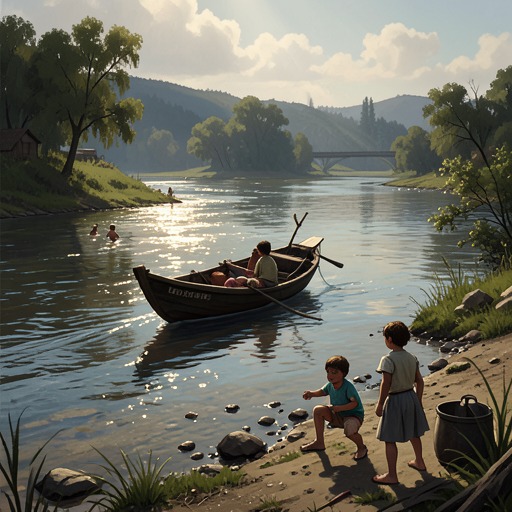
The Meenachal River as an Image of Boundaries and Fate
The God of Small ThingsThe Meenachal River is more than a setting in the lives of the family in Ayemenem: it is a boundary repeatedly crossed in secret or in hope, and a force that defeats the certainty of those who travel on it. Its water connects Ammu and Velutha’s meetings with the twins’ childhood expeditions, yet it also carries Sophie Mol to her death. The river’s capacity to conceal, connect, and take away makes it an image of fate that resists human mastery.
A Boundary Crossed in Secret
The river marks a passage between Ayemenem and the abandoned estate where Ammu and Velutha meet. Vellya Paapen tells Mammachi that he has seen the lovers cross night after night in a small boat, and that the boat waits by the bank when they are away. The crossing turns the river into a route for a relationship forbidden by the social order around them. It joins two people across a boundary that the surrounding community treats as decisive, while the hidden boat makes their meetings vulnerable to discovery.
The same geography frames Velutha’s final crossing to the History House. After midnight, with the river swollen by rain, he descends the thirteen stone steps, enters the water, and swims across toward the path through the swamp. The crossing is described as direct and accomplished in minutes, but its destination places him within the events that will lead to his death. The river offers a route, not protection: passage across it cannot undo the danger waiting on the other bank.
A Route the Children Cannot Control
For the twins, the river has been familiar enough to invite repeated journeys. Velutha has taught them to row diagonally upstream against the current, aiming toward the place they want to reach. When they set out in the dark with Sophie Mol, they follow that lesson toward the History House. Their confidence rests on prior experience, but this crossing takes place amid rain-swollen water and drifting branches and logs, which they cannot see in the darkness.
Near the far bank, their boat collides with a floating log and overturns. The twins have survived earlier capsizes by swimming after the boat and using it as a float; this time the current carries the boat away, and the darkness prevents them from finding it. They struggle toward shore, and Estha catches a low branch. What had been a familiar passage becomes a separation from the means of crossing—and from the confidence that repetition can make the river safe.
The River Takes and Yields
At dawn, a fisherman finds Sophie Mol in the water and draws her toward his boat with a bamboo pole. A silver thimble remains clenched in her fist. His recovery of her does not turn the river into a knowable space: the narration explicitly places its yield and its taking beyond prediction, even for someone who has fished there all his life. The river’s role in her death is not staged as a spectacular eruption. The tragedy comes through the quiet failure of the crossing and the loss that follows.
The contrast between the children’s familiar expeditions and this irreversible outcome gives the river’s image its force. Its currents carry branches, logs, and other debris along with the boat; the natural movement that makes the river a route also makes it an active danger. The river does not distinguish between what the children intend and what the water can do. Their aim is the other bank, but their passage ends in a loss they cannot reverse.
Current, Memory, and Uncertainty
The river’s meaning recurs through different crossings rather than settling into a single symbol. It is the lovers’ concealed passage, the twins’ practiced route, Velutha’s way toward the History House, and the setting in which a fisherman finds Sophie Mol. These uses connect private actions to consequences larger than the people who undertake them: the river can enable a meeting or a journey without granting control over what follows.
Its movement also holds together concealment and exposure. The lovers’ boat waits near the bank and makes their nightly passage visible to witnesses; the children enter the dark water unable to see the obstacles ahead; at dawn, the current brings Sophie Mol into view. The river therefore does not simply separate one shore from another. It makes the crossing itself uncertain, shifting between a means of connection and the medium through which loss becomes undeniable.
A Motif of Boundaries and Fate
The river’s repeated crossings give the novel a physical form for its tensions between desire and prohibition, childhood confidence and adult consequence, intended destination and actual outcome. Its banks define a boundary, but characters keep passing across it—often believing that skill, familiarity, or secrecy will be enough. Each crossing reveals the limits of that belief. A route can be learned; the river’s future cannot.
The image is neither a simple emblem of doom nor a benign natural backdrop. The river permits movement and conceals encounters, but it also carries the current that sweeps away the children’s boat and receives Sophie Mol. Its force lies in that double function: it joins separate shores while exposing travelers to consequences they cannot command. The Meenachal thus embodies the story’s recurring gap between what people set out to do and what happens to them.